
The world of economists and the real world
The normal routine for most people is a regular cycle of eating and sleeping. You expect to get up in the morning, have a breakfast of some sort, go out to work, break for some kind of snack or lunch, return home in the evening for dinner and then relax before going to bed. Of course, there are a thousand variations to this stereotypical pattern. Some people stay in to work, some people miss breakfast or settle for a quick coffee, some people have snacks rather than meals and so on. But the point is clear. Like other animals, human beings need to eat and to eat regularly in order to survive.
 Now consider a different scenario. For one month of the year, you find that food prices have fallen through the floor. You can eat what you like for almost nothing. The best restaurants in town will provide you with gourmet meals for a pittance. You can stock your fridge with luxuries as if they were necessities. You are going to take advantage of this. You probably wouldn’t eat yourself sick, but you’d buy a lot of things you wouldn’t normally even consider for purchase. Of course, there might well be supply problems induced by the massive increase in demand for everything from bread to caviar, and the low prices might drive farmers out of business and make the situation even worse where supplies are concerned. That is a point ACTION often makes. But for the moment we can put such considerations to one side.
Then, after the month of plenty, comes a month of want. Suddenly prices that had fallen through the floor have gone through the roof. Your loaf of bread costs about the same as a house. If you try to buy sausages you might as well be in the market for a diamond necklace. What do you do? Well, you decide that eating has become prohibitively expensive, and you aren’t going to eat at all. You’ll sit in your house and try to survive for a month on tap water and what’s left in the fridge (you didn’t stock up – after all, you’re opposed to the whole idea of food reserves). In the end you spend what would have been enough to stock the fridge for a fortnight in the first month on a single sweet (sweets are sold individually during the second month, while it was ‘all you can carry for a penny’ during the first). The downside, of course, is that even if bingeing in the first month made you feel rather sick (all those sweets!), at the end of the second month you’ll be very ill – quite possibly dead.
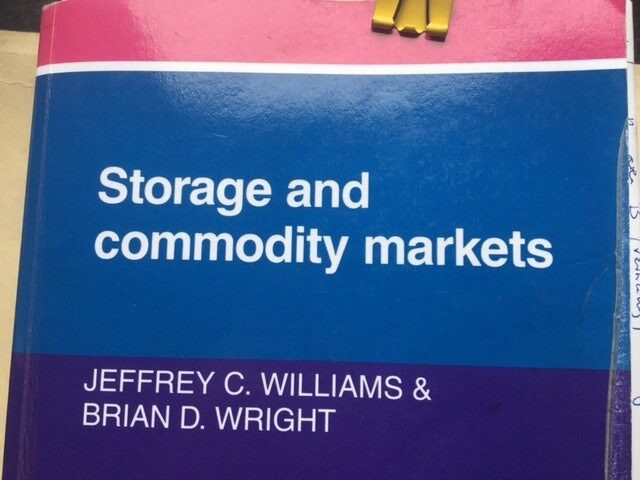
This is not a situation that many of us would like to be in. But then an economist comes along and tells us something interesting. He tells us that the money we save by spending very little during the month of plenty outstrips the money we lose by spending during the month when prices made food unaffordable. The price volatility has been good for our pockets. From an economic point of view, we have been able to act flexibly, indulging ourselves when food was cheap and tightening our belts when it was not. As Jeffrey Williams and Brian Wright point out (p.338) in their book Storage and Commodity Markets, (published by Cambridge University Press in 1991, with an online version available from 2010), ‘what consumers gain by low food prices more than compensates them for what they lose by high food prices.’
The point is accompanied by the inevitable graph showing that ‘average consumer surplus’ is greater where prices vary. A variable price gives ‘consumers flexibility to take advantage of lower prices by consuming more.’ And as we are reminded on page 335, ‘for economists in the neoclassical tradition, the natural choice of policy objective is some function of the welfare of individuals’ (p.335). And as the book makes clear, attempts to curb volatility by a system of food reserves such as ACTION would recommend is clearly going to be damaging to that welfare. It is yet another illustration of the fact that people have greater freedom and greater wealth when there are no acts of ‘interference’ in the market.
The economists quoted above are quite right. It may well be true that we will end up spending less if periods of plenty are allowed to oscillate with periods of want. The only problem is that applied to the real world, the cost of our financial gain will be that all of us will be desperately ill and many of us will be dead. And if that’s the best that the neoclassical tradition can do in order to promote the welfare of individuals, is it so surprising that it was a tradition that the economist John Maynard Keynes felt compelled to challenge? In the long run, Keynes famously said, we are all dead. The difference where some of his economist successors are concerned is that a lot of us would end up dead in the short run.