
Climate change is two challenges, not one
In this post, we are taking a break from food security. We are talking about climate change – an issue which clearly affects food security but which is an issue in its own right. The world has not yet figured out how to fix climate change, so we have decided to offer some of our own thoughts here.
 We are polluting the atmosphere with greenhouse gases. People drive petrol cars, firms generate electricity with fossil fuels and airlines fly planes. We risk an environmental catastrophe. We are polluting the atmosphere because we are doing ‘polluting activities’.
Even though we know that these activities are harming our environment, we do them nonetheless. At first sight this appears illogical. Why do we do things which are harmful to us? The answer is found in economics: the person or firm that does the activity reaps the benefit but does not pay the full cost. He pays only the financial cost, not the environmental cost. The environmental cost is a ‘negative externality’, picked up by society as a whole in the form of damage to the environment. If all polluters paid the full cost of their activities, there would not be a problem of climate change.
To stop climate change, governments need to bring down pollution. This is a national challenge. In principle, they could make the polluter pay the full cost of his activity – invoking the Polluter Pays Principle. Many governments have tried to do this by introducing environmental taxes but they have often met political resistance. Governments have also tried to introduce quotas on polluting activity but with little effect. The current vogue is a ‘clean energy transition’. But this is very expensive and also runs into political resistance.
I argue that a better approach could be a ‘nudging’ strategy, a combination of carrots, sticks and enabling measures to induce – not force – all of us to change our behaviour so that we pollute less.
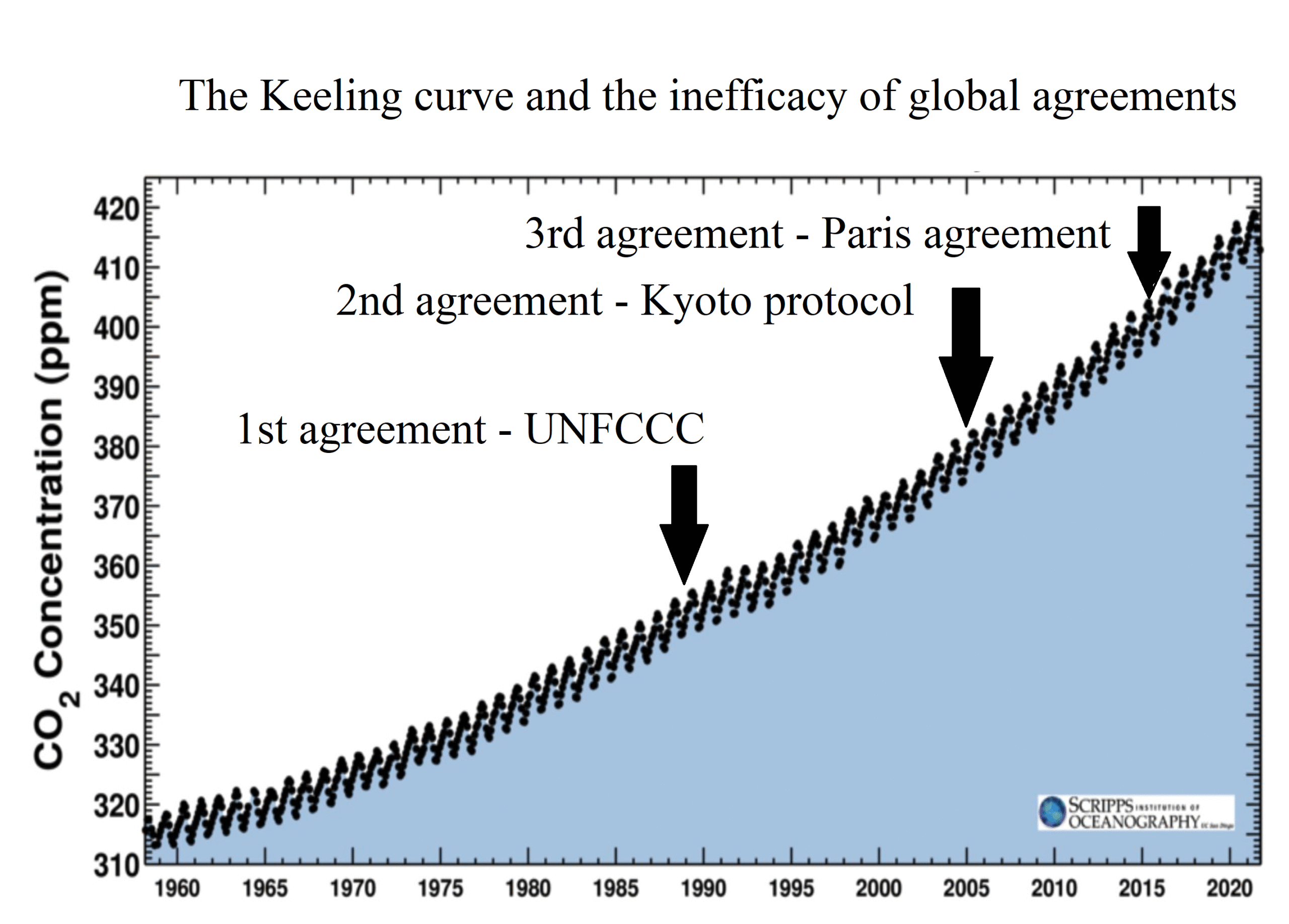
But there is little point a government introducing a nudging strategy if other countries do not cut their pollution too. Herein lies the second challenge – the challenge of collective action. We need all governments to act in harmony, agree a global climate plan and stick to it.
For the last 30 years, governments have tried to reach a global plan. So far success has been elusive. This is not really surprising: it was always unrealistic to expect all 200 governments, many of them more used to international competition than international cooperation, to agree on an issue as tortuous as climate change.
Previous collective action challenges (that of conflict between European countries and community discord in Northern Ireland) have been successfully addressed by a rare political technique: power-sharing. This could help to bring the cooperation that we need. Those countries which are serious about reducing pollution could agree a climate plan and, of vital importance, could agree to be bound by the plan. Other countries could participate as soon as they are prepared to respect the rules.
In short, I suggest a) a nudging strategy of carrots, sticks and enabling measures to reduce our pollution and b) a power-sharing ‘climate community’ to ensure the international cooperation that we need.